The Complete Rules of Ludo
Ludo is a family of race games built around one satisfying idea: get four tokens from your yard, around a cross-shaped track, and up your private home column before anyone else. Most variants share the same skeleton - captures by landing on an enemy, bonus throws for lucky rolls, and an exact count to finish. What changes between games is everything else: one die, two dice or six cowrie shells; how tokens enter the track; where they are safe; whether two tokens can wall off a square; and how much mercy the board shows.
This page collects the rules for every game on Ludo.now. Each section covers the goal, the legal moves, and the details that trip up new players - With a link to jump straight into a game. If you're brand new, start with Classic Ludo (the standard), speed things up with Quick Ludo, or try Pachisi if you prefer a slower, more defensive race. Playing at a real table? Grab our board to print at home.
💡 New to Ludo? Every game below shares the same core idea - race your tokens around the cross and home. Learn one and the rest come quickly.
Every Ludo game at a glance
Skim the whole family first, then jump to the full rules for any game below.
| Game | Enter the track on | Safe squares | Difficulty |
|---|---|---|---|
| Classic | A six (one die) | 8 (starts + stars) | Easy to learn |
| Quick | Any roll | 8 (starts + stars) | Fast & forgiving |
| Team | A six (one die) | 8 (starts + stars) | Coordination matters |
| Pachisi | A grace: 6, 10 or 25 cowries (first piece: any throw) | 12 castles | The ancestor of them all |
| Parcheesi | A five - one die or both dice totaling five | 8, plus blockades | Blockades change everything |
| Uckers | A six (two dice) | Doorsteps only, plus barriers | Naval-grade aggression |
| Mensch | A six (one die) | None | Pure knockabout |
| Fia | A one or a six | None | Nordic and nimble |
Classic Games
Classic Ludo
2-4 (you vs smart AI) · Easy to learn · ~25% baseline in a 4-player game - good choices roughly double it
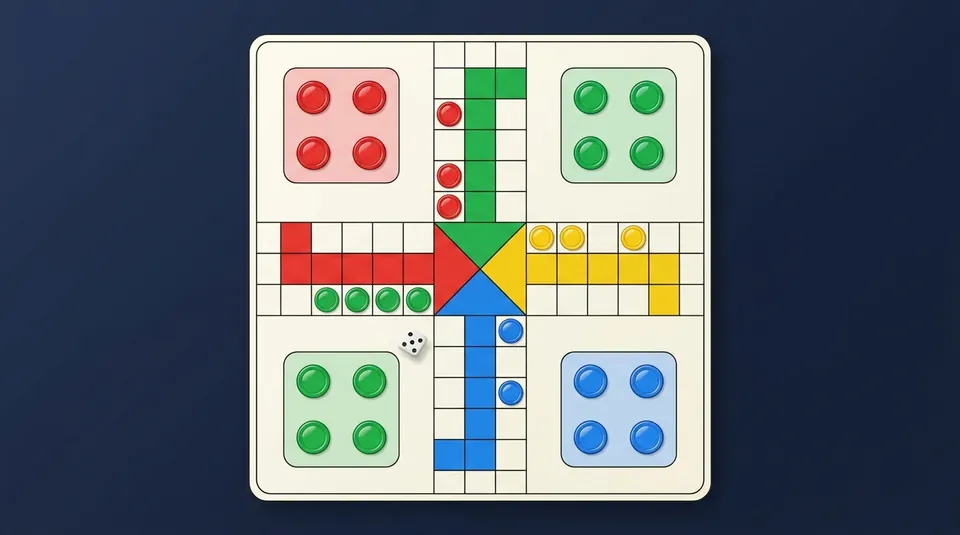
Classic Ludo is the board game everyone grew up with: four coloured yards, a cross-shaped track, one die, and a race that swings on every roll. You control the red tokens against two or three computer opponents. Roll a six to move a token out of your yard onto the track, then race it clockwise around the board toward your home column. Land on a square an opponent occupies and you send their token all the way back to its yard - and they can do the same to you. Star squares and start squares are safe ground where nobody can be captured. A six always earns another roll, but three sixes in a row ends your turn on the spot. The first player to walk all four tokens up their home column wins. Every game here is free, loads instantly, and needs no download or signup.
Roll a six to leave the yard
All four of your tokens start in the yard. You need a six to move one onto your start square. Rolling a six also gives you another roll, so a good opening can put a token on the track and push it forward in the same turn.
Race clockwise around the track
Each roll moves one token that many squares clockwise around the cross-shaped track. When you have more than one token out, you choose which token uses the roll - that choice is where all the skill in Ludo lives.
Capture opponents by landing on them
Land exactly on a square holding a single enemy token and you knock it back to its yard. It must roll a six to start over. You cannot capture tokens resting on a star square or on their own start square.
Use the safe squares
Eight squares are safe: the four coloured start squares and the four starred squares. A token parked on safe ground cannot be captured, so plan your moves to hop from one safe square toward the next when enemies are close behind.
Bring all four tokens home
After a full lap, each token turns up its own coloured home column. Home squares are private, so nothing can be captured there, but you need an exact roll to step onto the final home triangle. First player with all four tokens home wins the game.
Fast & Casual Games
Quick Ludo
2 or 4 (you vs AI) · Fast & forgiving · Games finish in 5-10 minutes
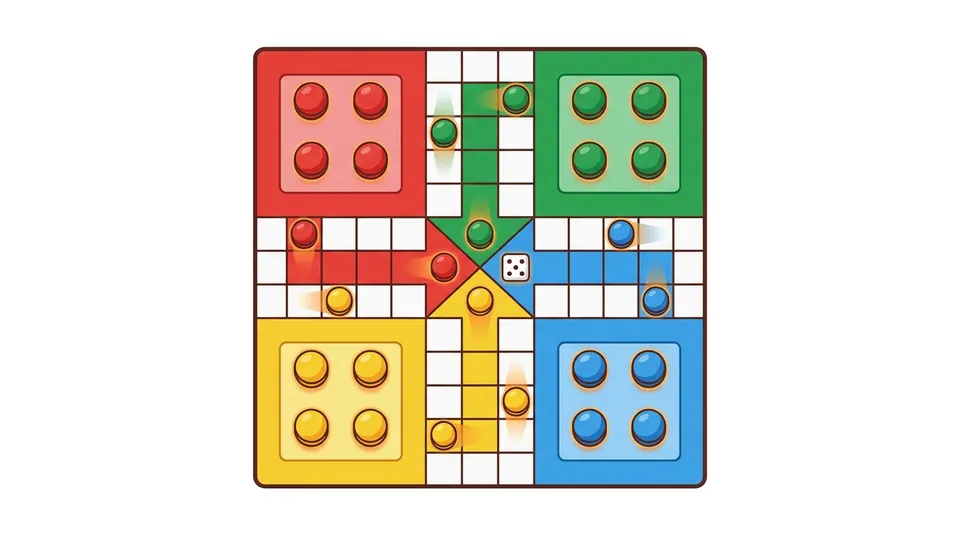
Quick Ludo is Classic Ludo with the waiting removed. The board is the familiar 52-square cross, but any roll - not just a six - brings a token out of your yard, and every player begins with one token already standing on their start square. Best of all, the race is shorter: the first player to bring just two tokens home wins. Captures still sting, sending tokens all the way back to the yard, a six still earns an extra roll, and three sixes in a row still ends your turn. Star squares and start squares remain safe ground. Because the finish line is so close, every capture and every escape can decide the whole game. Play the 2-player or 4-player mode as red against smart computer opponents. A full game takes 5 to 10 minutes, runs free in your browser, and needs no download and no signup.
Start with a token on the track
Every player begins the game with one token already on their start square, so you have a runner from the very first roll. The start square is safe ground, but the moment you step off it, the race - and the risk - begins.
Leave the yard on any roll
You never wait for a six in Quick Ludo. Any number can move a token from your yard onto your start square, so fresh runners are always one roll away. A six still earns you an extra roll, and three sixes in a row still ends your turn.
Race clockwise and capture
Each roll moves one token that many squares clockwise around the cross. Land exactly on a square holding a single enemy token and it goes straight back to its yard. Tokens on star squares or their own start square cannot be touched.
Pick which token takes the roll
When several of your tokens can move, you decide which one uses the roll. In a race this short, that choice matters even more than in Classic Ludo - one smart dodge or one well-timed capture can swing the whole game.
Bring two tokens home to win
After a full lap, each token climbs its own home column, where opponents can never follow. The final step onto the home triangle needs an exact roll. The first player to walk two tokens all the way home takes the game.
Team Play Games
Team Ludo
4 in fixed pairs (2v2) · Coordination matters · Teams win or lose together - one strong runner is not enough
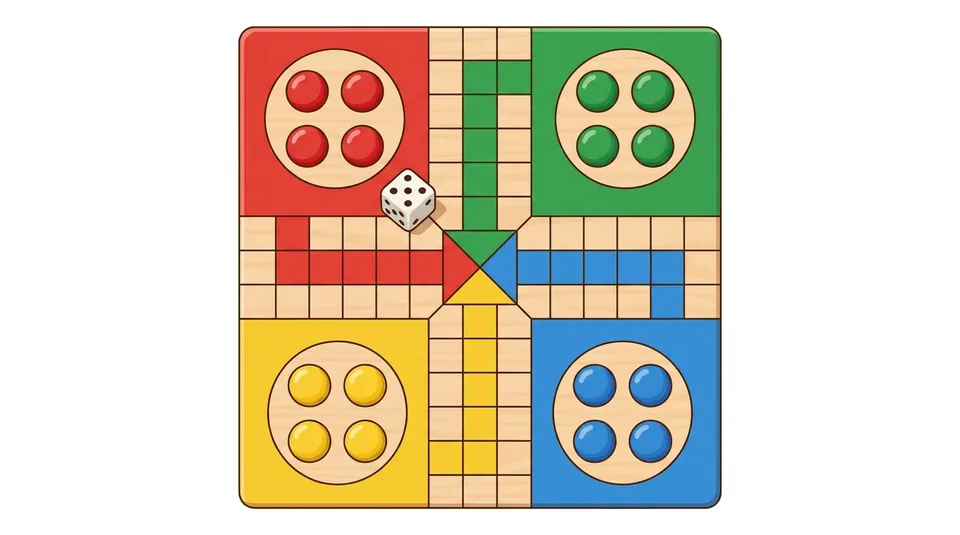
Team Ludo is the classic race played as a true partnership: you and an ally against two opponents. You control the red tokens, a computer partner plays yellow, and together you face the team of green and blue. All the Classic rules apply - roll a six to leave the yard, earn an extra roll for every six, lose your turn on three sixes in a row, and land by exact count to finish. Eight safe squares still shelter tokens from capture. The twist is the goal: your team wins only when all eight tokens, your four and your partner's four, reach home. Teammates can never capture each other - landing on your partner's token simply shares the square. That one rule changes everything, because guarding yellow's runners and clearing threats from their path matters as much as moving your own. Free in your browser, with no download and no signup.
Know your team
Team Ludo is two against two: you control red, a computer partner controls yellow, and you face the allied team of green and blue. Partnerships are fixed for the whole game - you win together or lose together.
Play by the Classic rules
Everything you know from Classic Ludo applies. Roll a six to move a token out of the yard, take an extra roll after every six, and lose your turn if you roll three sixes in a row. Tokens race clockwise and need an exact roll to finish.
Share squares with your partner
You can never capture yellow, and yellow can never capture you. If your token lands on a square your partner occupies, the two simply share it. Only green and blue tokens are captured by landing on them - and they can capture you and your partner right back.
Use the eight safe squares
The four coloured start squares and the four star squares protect any token standing on them. Steer your runners - and keep an eye on your partner's - from one safe square toward the next whenever enemy tokens prowl behind.
Bring all eight tokens home
Your team wins only when every red and every yellow token has climbed its home column - all eight of them. If green and blue land their eight first, you lose. Finishing your own four is only the halfway mark, so help your partner the whole way.
Historic Roots Games
Pachisi
2-4 (you vs AI) · The ancestor of them all · Grace throws of 6, 10 and 25 repeat your turn - twelve castles keep you safe
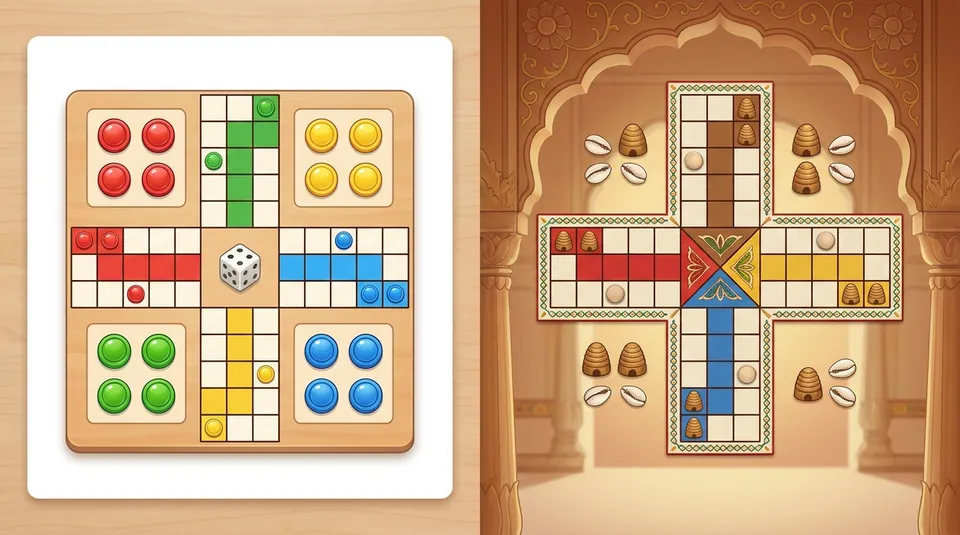
Pachisi is the royal race game of India, and our version now throws it the traditional way: with six cowrie shells instead of a die. The shells that land mouth up count your move. Two to six mouths up move a piece that many squares, a single mouth up scores 10, and no mouths at all scores 25 - the throw the game is named after. Throws of 6, 10 and 25 are graces: a grace can bring a fresh piece in from the yard, and you always throw again after one. Your first piece may enter on any throw, but every later piece must wait for a grace. Twelve castle squares shelter pieces from capture, capturing an enemy earns another throw, and pieces finish at the charkoni in the centre, where any big throw carries them the rest of the way home. You play red against smart AI, free in your browser, no signup.
Throw six cowrie shells
Instead of rolling a die, you toss six cowrie shells and count how many land mouth up. Two, three, four, five or six mouths move a piece that many squares. Exactly one mouth up scores 10, and zero mouths up scores 25, the biggest throw in the game.
Enter the board with graces
Throws of 6, 10 and 25 are called graces. Your first piece may walk out of the yard on any throw, but every piece after it needs a grace to enter. A grace also wins you another throw, so opening the gate never slows you down.
Pick the piece for each throw
Every throw moves one piece clockwise around the cross. Once several pieces are on the track you choose which one takes the number, and since throws range from 2 all the way to 25, matching the right piece to the right distance is the heart of the game.
Hold the twelve castles
Twelve castle squares guard the track: the four starts, the four stars, and four more spaced evenly around the loop. A piece resting on a castle cannot be captured, so careful players travel castle to castle like stepping stones across a river.
Capture, then bring them home
Land on an enemy piece outside a castle and it returns to its yard - and you throw again. Pieces finish at the charkoni in the centre of the board, and since cowrie throws skip the number 1, there is no exact count: a throw larger than the distance left still carries the piece home.
World Variants Games
Parcheesi
2-4 (you vs AI) · Blockades change everything · Doubles roll again - but a third doubles sends your lead pawn home
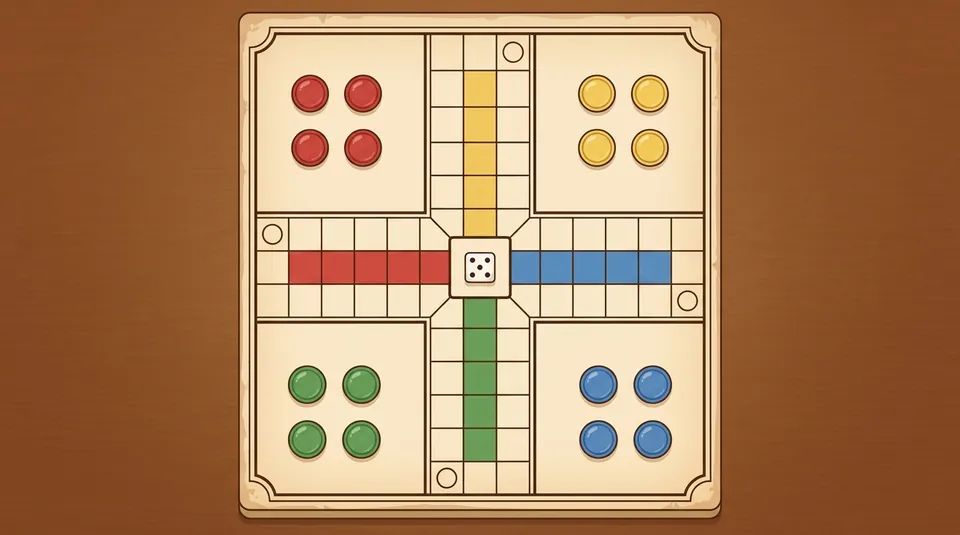
Parcheesi is America's classic take on Pachisi, and our version now plays it the real way: with two dice. Every throw gives you two moves - one pawn per die, split between two pawns or stacked on the same one. Pawns leave the nest on a five, either straight on one die or as 4 and 1 or 3 and 2 combined. Doubles earn another throw, and when all four of your pawns are out, doubles move the tops and the bottoms of the dice: four moves worth 14 squares. A third doubles in a row sends your lead pawn back to the nest. Capture an enemy pawn and you win a bonus move of 20 squares; bring a pawn home and you earn 10 more. Two of your pawns on one square wall the track completely. You play red against a smart AI, free in your browser, with no download and no signup.
Leave the nest on a five
All four pawns start in the nest and need a five to come out. A five on either die opens the door, and so does a pair adding up to five - 4 and 1, or 3 and 2 - though the combined entry spends both dice. An entering pawn even captures an enemy parked on your start square.
Throw two dice, make two moves
Each die moves one pawn its own number of squares. You may give one die to each of two pawns, or feed both to a single pawn as two separate steps. A die that no pawn can legally use is simply lost, so keep your pawns spread where every number has work.
Ride your doubles - carefully
Doubles always earn another throw. When all four of your pawns are out of the nest, doubles get richer: you move the tops and the bottoms of both dice, four moves totalling 14 squares. But a third doubles in a row sends your lead pawn straight back to the nest and ends your turn.
Wall the track with blockades
Move two of your own pawns onto one square and you have built a blockade. Nothing may land on that square or pass over it - enemy pawns, and your own pawns too, all stop dead until you break the pair. Well-placed walls choke the board; badly placed ones choke you.
Cash your bonuses and finish
Capturing an enemy pawn earns a bonus move of 20 squares for any one pawn at the end of your turn, and bringing a pawn home earns 10 the same way. If no pawn can use a bonus, it is lost. The last square demands an exact count, and all four pawns home takes the game.
Uckers
2 (1v1) or 4 (2v2 partners) vs AI · Naval-grade aggression · Two dice and barriers make comebacks common
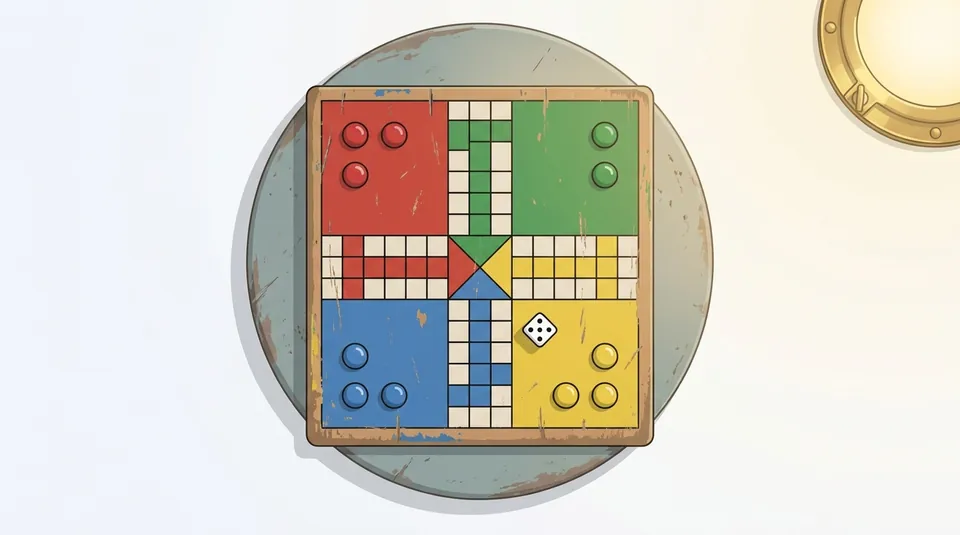
Uckers is the Royal Navy's fighting version of Ludo, and this free browser edition plays it the proper messdeck way: with two dice. Every throw gives you two numbers to spend - split them between two pieces, stack both on one piece, and forfeit whatever you cannot use. A six brings a piece out of the base onto your doorstep, and any throw holding a six earns another throw. A double six can launch two pieces at once, and snake eyes on the game's very first throw puts every piece on the board - all bits out. Two of your own pieces on one square form a barrier no enemy can land on or pass. Play 1 vs 1, or the traditional 2 vs 2 with your yellow AI partner against green and blue. Land on a lone enemy piece and you uck it off back to its base. First side to get every piece home wins.
Throw two dice and spend both
Every turn you throw two dice, just like on a real messdeck. Use one die on each of two pieces, or put both numbers onto a single piece for one long move. A die that no piece can legally use is forfeited, so keep your pieces spread out where every number has work to do.
Roll a six to reach your doorstep
A six lifts a piece out of the base onto your doorstep, the start square outside your base, and any throw holding a six earns another throw. A double six can bring two pieces out together. If the game's very first throw is snake eyes - a 1 and a 1 - every piece of every player comes out at once: all bits out.
Build barriers to own the track
Put two or more of your pieces on one square and you have a barrier. Enemy pieces cannot land on it and cannot pass it, so they queue up behind your wall while the rest of your side runs. A barrier never blocks your own pieces, and in the partners game it never blocks your partner either.
Uck lone enemies back to base
Land by exact count on a square holding a single enemy piece and you uck it off - straight back to its base to wait for another six. Only the doorsteps are safe ground; there are no star squares in Uckers, so every lone piece on the open track is a target.
Bring your side home
After a full lap each piece climbs your private home column, and the last step needs an exact count. In 1 vs 1 the first player with all four pieces home wins. In the 2 vs 2 partners game victory goes to the first team to bring all eight of its pieces home.
Mensch ärgere Dich nicht
2-4 (you vs AI) · Pure knockabout · Without safe squares, captures decide most games
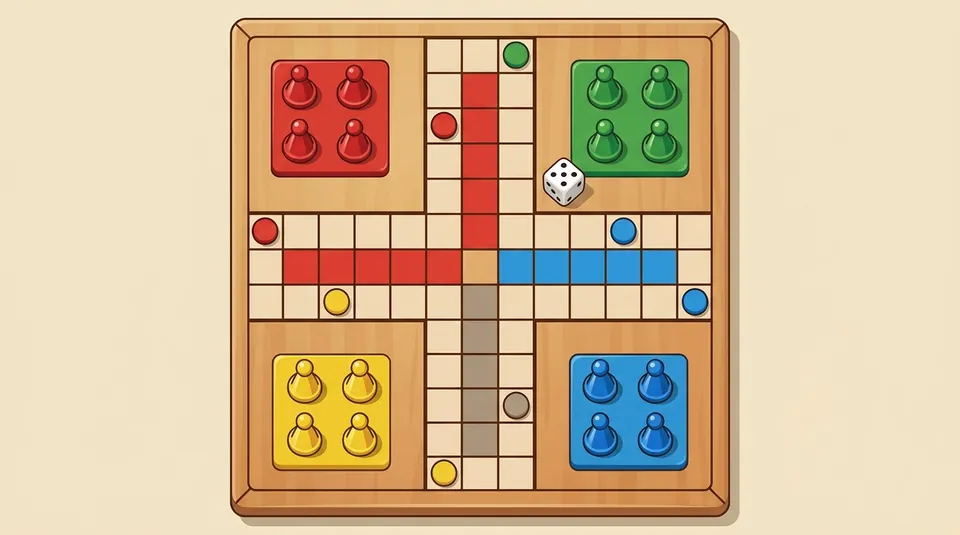
Mensch ärgere Dich nicht means 'Don't get annoyed, man', and Germany's favourite board game spends every turn testing that advice. This free browser version follows the official rules in all their cheerful cruelty while you play red against smart AI opponents. One die, no safe fields anywhere - not even the start fields - and a capture lurking on every corner. A six is compulsory: while tokens wait in your yard, it must bring one out, and a token sitting on your start field has to move along before anything else may. When your whole team is stuck in the yard, you get three throws to hunt for that six. Your own tokens never share a field, you must move whenever a legal move exists, and every six earns a fresh throw with no three-sixes penalty. Walk all four tokens home on exact throws to win - and keep smiling.
Find a six to leave the yard
Only a six brings a token from your yard onto your start field, and every six earns another throw. When everything you own sits in the yard or already at home, the rules grant you up to three throws per turn to hunt for that six, so a slow start never lasts long.
Obey the entry and start-field rules
Entering is compulsory: while tokens wait in your yard, a six must be spent bringing one out if the start field is playable. And a token standing on your start field - the A field on a German board - must move on before your other tokens may, so the doorway never stays blocked.
Capture anywhere on the track
There are no safe fields in this game - no stars, and not even the start fields protect anyone. Land by exact count on any enemy token and it flies back to its yard to begin all over again. Expect the same treatment in return, constantly.
Move when the die says move
If any legal move exists you must make one, however painful. Your own tokens can never share a field either, so a throw that would land a token on one of your own cannot be used by that token. Careless crowding throws away moves.
Shepherd all four tokens home
After a full lap each token turns into your private home column, out of reach at last. The final field takes an exact throw, so the endgame becomes a small numbers puzzle. First player to tuck all four tokens home wins.
Fia
2-4 (you vs AI) · Nordic and nimble · Two entry rolls mean far less waiting in the yard
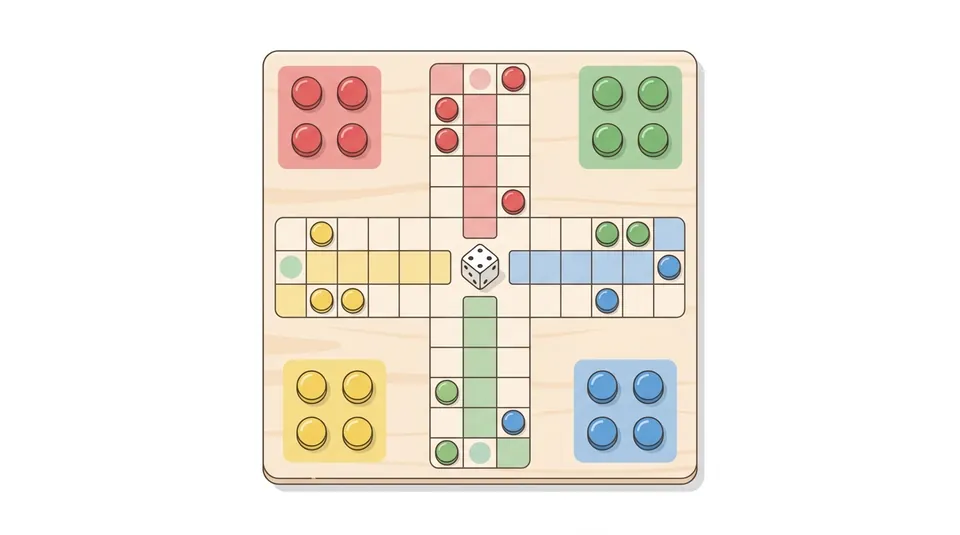
Fia is Sweden's beloved take on Ludo, played here on the same 52-square cross board. Its full name, Fia med knuff, means 'Fia with a push', and pushing is the heart of the game. A token may leave the yard on a one or a six, so the race begins quickly and the track fills fast. There are no safe squares at all, and two of your own tokens can never share a square, which means every piece stays exposed from its first step to its last. Land exactly on an enemy token and you knuff it back to its yard. A six earns an extra roll, and there is no three-sixes penalty to cut a hot streak short. Each token needs an exact roll to step home, and the first player to bring all four home wins. You play red against the AI, free in your browser, no download or signup.
Leave the yard on a one or a six
Each of your four tokens starts in the yard, and a roll of one or six moves one of them onto your start square. That is twice as many entry numbers as Classic Ludo allows, so expect all four colours on the track within a few turns. A six still earns you another roll on top.
Race clockwise round the cross
Every roll moves one token that many squares clockwise along the shared 52-square track. Because two of your own tokens can never stand on the same square, a move that would land on your own piece is not allowed - choose another token or another plan.
Push enemies back to their yard
Land by exact count on a square holding an enemy token and you push it - the famous knuff - all the way back to its yard. The pushed token can return on a one or a six, so a knuff stings without ending anyone's game.
Stay moving, because nowhere is safe
Fia has no star squares and no protected start squares. Any token on the track can be pushed at any time, so survival comes from spacing, not parking. Keep your tokens more than six squares ahead of anything that can reach them.
Finish with exact rolls
After a full lap each token turns into its own home column, where enemies can never follow. The last step onto the home triangle needs an exact roll, so oversized numbers must go to another token. Bring all four tokens home and you win.
A few terms that apply everywhere
Yard & start square
The yard is your corner base where tokens wait to enter. Your start square is the coloured cell where they land when they come out - in most variants it doubles as safe ground.
Track & home column
The 52-square track loops the whole cross; every player races it clockwise. After a full lap each token turns up its own coloured home column, which opponents can never enter.
Captures
Land exactly on a square holding a single enemy token and it goes back to its yard to start over. Safe squares - where they exist - block captures entirely.
The bonus throw
Most variants reward a lucky throw with another one: a six in the Ludo family (three in a row end your turn), doubles in Parcheesi, and graces of 6, 10 or 25 in cowrie-thrown Pachisi.
Ready to put the rules to work? Try today's Daily Challenge, race a friend in Multiplayer, or check the FAQ for common questions about Ludo in general.
Ludo rules FAQ
How do you play Ludo?
Roll a six to move a token out of your yard onto your start square, then race your four tokens clockwise around the 52-square cross track and up your private home column. Land exactly on an enemy token to send it back to its yard. The first player to bring all four tokens home wins.
What is the goal of Ludo?
In every variant the goal is the same: get your tokens all the way around the board and into your home triangle before your rivals. Variants change how tokens enter, where they are safe, and whether tokens can block squares - not the goal.
Which Ludo game is the easiest to learn?
Quick Ludo is the friendliest starting point - any roll brings a token out and only two tokens need to finish. Classic Ludo against a single AI opponent is a close second.
Which Ludo game is the hardest?
Mensch ärgere Dich nicht and Fia are the toughest here: with no safe squares anywhere, every token you own can be captured on every enemy turn.
Do you always need a six to start?
No - that's Classic Ludo's rule. Parcheesi enters on a five, Fia on a one or a six, and Quick Ludo on any roll at all. Each game's section below spells out its entry rule.
Want more answers? See the full Ludo FAQ (40 questions) or look up any term in the glossary, then move on to our articles on playing better Ludo.