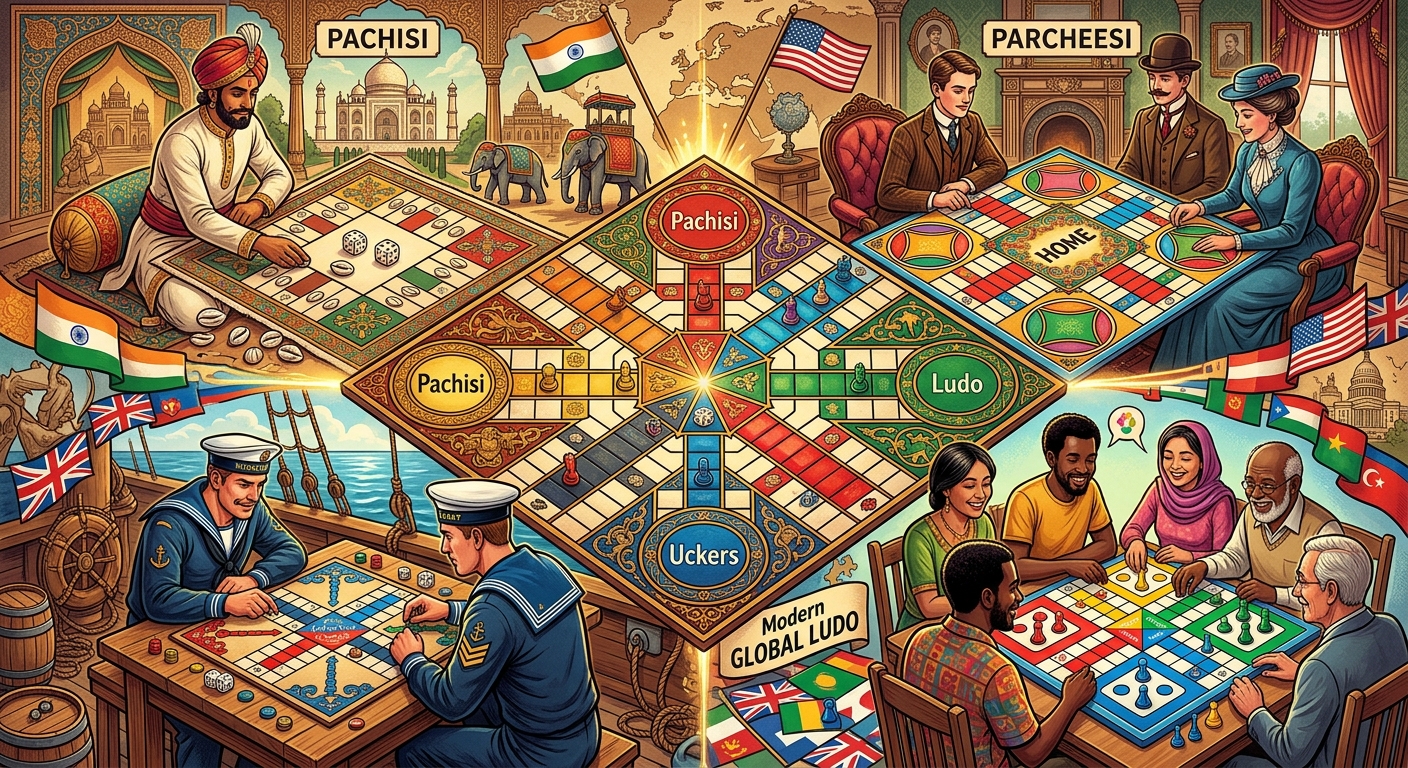
Open a box of Ludo with someone from India, and they might tell you it feels like a stripped-down version of something far older. Sit down with a retired Royal Navy sailor, and they will insist the game they grew up with plays nothing like the version sold in toy shops. Board games travel. They pick up local flavors. They gain new rules, lose old ones, and sometimes change names entirely. Ludo is one of the world's best examples of this. Its family tree stretches back over a thousand years, across continents, into barracks and living rooms and game nights everywhere.
Five games, one ancestral board.
- Pachisi, the Indian ancestor of Ludo, introduced the cross-and-circle board and team play that modern variants still echo today.
- Games like Parcheesi, Uckers, Mensch ärgere Dich nicht, and Fia each adapted those foundations to fit their culture, audience, or setting.
- A seasoned Ludo player can step into any of these variants, but each one demands a specific set of mental adjustments to play well.
The Ancient Indian Game That Started It All
Long before Ludo existed, players in India were gathering around a cloth board shaped like a cross. The game was Pachisi. Its name comes from the Hindi word for twenty-five, the highest score possible on its shell dice. Historical records and carvings place the game at the Mughal court in the sixteenth century. Emperor Akbar famously played it on a life-sized stone board at his palace in Fatehpur Sikri, using attendants as the moving pieces. The documented past of Pachisi reaches even further back than that, with evidence suggesting it was played in northern India as early as the sixth century AD.
British observers in the nineteenth century encountered the game and took it home. They simplified the rules, replaced the cowrie shell dice with a standard cube, and eventually filed a patent. That 1896 British patent became what we now call Ludo.
What distinguishes Pachisi from Ludo most sharply is team play. In Pachisi, two players team up against two others. Partners share a single goal: get all eight pieces home before the opposing pair does. That cooperative layer completely changes the psychology of the game. You stop thinking purely about your own pieces and start calculating moves that protect or advance your partner's position.
How Parcheesi Became America's Version of the Game
Parcheesi arrived in the United States in the 1860s after a games company licensed a version of the Indian game. It became so popular that the brand name eventually became a registered trademark, and for decades it was a fixture in American homes. The box sat in the cupboard alongside Monopoly and Scrabble, pulled out whenever a family needed something everyone could play together.
Parcheesi sits closer to Pachisi than to standard Ludo. The board uses a 68-space track rather than Ludo's 52-space circuit. Movement is driven by two standard dice rolled together, not one. Players add up both dice values and decide whether to split that movement between two pieces or apply it all to one. That single rule opens a world of tactical decisions that Ludo's single-die roll simply does not offer.
A few Parcheesi mechanics feel genuinely foreign to a Ludo player stepping in for the first time:
- Blockades: Two pieces of the same color sitting on the same space create a blockade that no opponent can pass. It holds until you voluntarily move one of those pieces.
- Safety spaces: Marked directly on the board, these spaces make any piece sitting on them immune to capture, no matter what.
- Bonus moves: Getting a piece home rewards you with a ten-space bonus move for another piece still on the track.
- Split or combine: Every roll gives you the choice to distribute movement across two pieces or commit it all to one, making each turn a small puzzle worth thinking through carefully.
Parcheesi rewards patience and planning in a way that casual Ludo rarely demands. The board is larger, the decisions are more numerous, and the tension of a well-held blockade can stretch across many turns.
Uckers: The Game the Royal Navy Made Its Own
Mention Uckers to someone who served in the British Royal Navy and watch their face change. This is not a polite, living-room game. Uckers is intense, loudly competitive, and governed by an unofficial ruleset that varies from ship to ship and base to base. The board is standard Ludo, but the social and tactical layers that grew up around it in military service made it something else entirely.
The core ways Uckers differs from standard Ludo:
- Mandatory team play: Uckers is almost always played in pairs. You and a partner work against two opponents, with pieces of two colors moving toward a shared victory.
- Blobs: Partners can block for each other. Two pieces of different colors sitting together form a combined blockade called a blob. Opponents cannot pass a blob any more than they can pass a standard double.
- Ruthless captures: The culture around captures is more aggressive than in civilian Ludo. Sending a piece back to base is celebrated loudly, not simply noted.
- Ship-specific house rules: Double sixes, entry rules, and capture exceptions vary by unit or vessel. Always ask before you assume anything.
What makes Uckers fascinating is how fiercely its rules are defended locally. Ask two Uckers veterans to play together and they may spend fifteen minutes arguing about which variation applies before a single piece moves. That argument is, arguably, part of the game itself.
Germany's Mensch ärgere Dich Nicht and Sweden's Fia
Continental Europe developed its own takes on the cross-and-circle format. In Germany, Mensch ärgere Dich nicht ("Man, don't get annoyed") was published in 1914 and became one of the best-selling games in German history. The title tells you everything about its emotional register. Getting sent back to start is not just a setback. It is the entire point.
The German version plays on a cross-shaped board with a slightly different spatial layout than standard Ludo. One notable rule stands out: if you roll a six and have no piece in play yet, you must bring one out. You cannot pass or move an existing piece instead. That rule forces confrontation from the very beginning. Hiding safely in your start area while an opponent races ahead simply is not an option.
Sweden's Fia, short for Fia med Knuff (roughly "Fia with a shove"), operates on a similar spirit. The game is a staple of Swedish summers, often played on large outdoor versions at garden parties and campsites. Fia uses a distinctive board with colored rosettes and handles team play slightly differently depending on regional tradition. Like Uckers, local rule variations are common and fiercely upheld by those who grew up with them.
Before You Play: Mapping Your Table's Board Game History
If you are planning a multicultural game night built around these variants, it helps to know what everyone at the table has actually played before. Running a have you ever game round at the start is a low-effort way to do exactly that. Players tick off which games they have encountered, and suddenly you have an instant picture of who brings Parcheesi experience, who grew up with Mensch ärgere Dich nicht, and who has never seen anything beyond standard Ludo. It sets expectations, sparks conversation, and gives the group a shared reference point before the first die hits the table.
How These Five Variants Compare Side by Side
| Game | Origin | Team Play | Dice Used | Standout Rule |
|---|---|---|---|---|
| Pachisi | India | Yes (2v2) | Cowrie shells | Partners share a victory; eight pieces in play |
| Parcheesi | USA (via India) | Optional | Two standard dice | Blockades, safety spaces, and bonus home moves |
| Uckers | UK (Royal Navy) | Yes (mandatory) | One die | Cross-color blobs and vessel-specific house rules |
| Mensch ärgere Dich nicht | Germany | No | One die | Forced piece entry when rolling a six |
| Fia | Sweden | Varies by region | One die | Rosette board, outdoor culture, strong local traditions |
What a Ludo Player Needs to Unlearn and Relearn
If standard Ludo is your home base, stepping into any of these variants will feel familiar for the first thirty seconds. Then the gaps appear. Here are the most important mental shifts to make before you sit down at an unfamiliar board:
- Stop thinking solo. In Pachisi and Uckers, your moves affect a partner directly. A piece you sacrifice might open a lane for them. A blockade you hold might be frustrating your own team. You have to hold two board states in mind at once.
- Get comfortable with two dice. Parcheesi uses two dice, and the decision to split or combine that movement is a genuine tactical choice on every single turn. Ludo's single-die roll never asks you to make that call. Give yourself time to think through both options before you commit.
- Learn what counts as a safe space. Standard Ludo offers very limited protection for pieces in transit. Parcheesi's designated safety spaces change the calculus on where to park a vulnerable piece. Memorize the layout early rather than discovering a safe zone only after you needed it.
- Adjust your aggression level. Mensch ärgere Dich nicht and Uckers are emotionally sharper than Ludo because the captures feel more personal. The social dynamics around sending someone home are part of the experience. Lean into it rather than apologizing for a good move.
- Ask about house rules before the game starts. Uckers has no universal rulebook. In Fia, local traditions vary by town and by family. The moment you assume the rules match what you already know is the moment you land in trouble.
The Ludo DNA That Runs Through Every Variant
Underneath all those differences, the family resemblance is unmistakable. Every one of these games shares the same core loop. Roll, move, capture, survive, get home. The cross-and-circle layout channels pieces along a predictable path while keeping the board open enough for confrontation. That structure has proved remarkably durable across cultures, centuries, and very different contexts.
What varies is everything surrounding that loop. The number of dice, the meaning of a six, the presence of a partner, the power of a safe space. Those variables shift the game from luck-heavy to strategy-heavy and back again. They shift it from a solo race to a team contest. They shift the emotional tone from light fun to something that gets genuinely heated around the table.
The shared ancestry also means that skills carry over between games. A strong Parcheesi player understands blocking better than most new Ludo players do. A seasoned Uckers pair has an intuitive feel for team coordination that pays off immediately in Pachisi. The family connection runs deep enough to be useful, not just historically interesting.
One Board, a Thousand Years, and Your Next Roll
The best way to understand any of these games is to play one. Reading about Parcheesi's blockade rules is useful. Watching someone hold a blockade for six turns and seeing the effect it has on the rest of the board is something else entirely.
If you want to feel the difference between these variants without hunting down a physical copy of each, ludo.now has browser-based versions ready to go at any time. No setup. No missing pieces. No arguing about which ruleset applies. Just a board, a roll, and the same essential game that has been keeping people entertained for well over a thousand years.
The global family of Ludo games is wider than most players realize. Somewhere in that family, there is almost certainly a version that suits your particular appetite for risk, strategy, and friendly competition. You only have to try a few to find out which one that is.