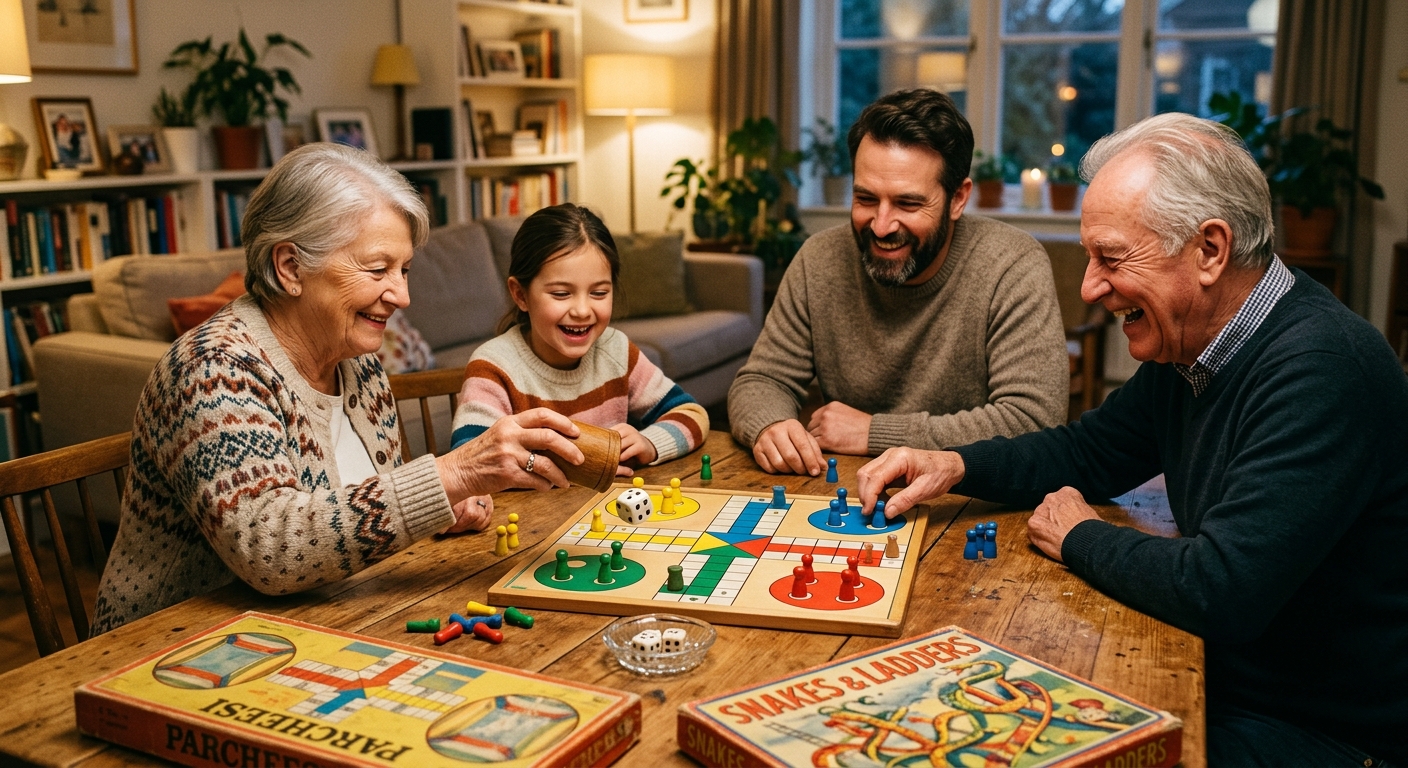
Roll the die, move your token, send your rival back to start. It sounds almost too simple to be compelling. Yet across living rooms in Lagos, Mumbai, London, and São Paulo, this same ritual has drawn families together for generations. Ludo is deceptively humble. Its board fits on a coffee table. Its rules can be explained in minutes. And its ability to produce genuine excitement, laughter, and the occasional heated argument has never faded. That staying power deserves a closer look.
Ludo's universal appeal is not an accident. It is the product of more than a thousand years of game design refined by real human play across real communities.
- The game descends from Pachisi, one of the oldest cross-and-circle games ever recorded, originating in ancient India.
- British colonists adapted it into Ludo in the late 19th century, and the simplified version spread across continents with remarkable speed.
- Dozens of distinct cultural variants exist today, each preserving the dice-and-token formula while reflecting its own local setting.
From Mughal Courts to Victorian Parlors: The Deep Roots of Pachisi
Long before cardboard boxes lined toy shop shelves, people were playing a version of Ludo on cloth boards in the imperial courts of India. The game known as Pachisi dates back at least to the 6th century CE, and possibly much earlier. It was played on a cross-shaped board using cowrie shells as dice and coloured tokens to represent competing players. The Mughal emperor Akbar is reported to have played a life-sized version in his courtyard at Fatehpur Sikri, using actual people who moved across squares of the palace floor.
That image says a great deal about what Pachisi offered. It combined chance and strategy in equal measure. A lucky throw could change everything. A clever block could frustrate a rival who seemed to be running away with the game. The mechanics were simple enough for anyone to join, but layered enough to keep experienced players thinking several moves ahead.
When British colonists encountered Pachisi in India during the 19th century, they were fascinated by it. They brought it back to Britain, adjusted the rules slightly, swapped the cowrie shells for a standard cubic die, and registered a patent under the name Ludo in 1896. The name comes from the Latin word for "I play." That rebranding was the beginning of something enormous.
How Ludo Crossed Every Border
Ludo did not stay in Britain for long. The game's structure was strong enough to adapt to almost any cultural context. Different countries took the core formula and made it their own, adjusting rules, board colours, naming conventions, and even the social rituals surrounding play. The result is a remarkable family of games that share the same skeleton but wear very different clothes.
Here is how the game took root in different parts of the world:
- Parcheesi (United States): Marketed as "the royal game of India," Parcheesi introduced its own set of rules and became a staple of American family game nights from the late 19th century onward.
- Mensch ärgere Dich nicht (Germany): Translated roughly as "Don't get annoyed," this German variant became one of the best-selling board games in the country's history, particularly during World War I when copies were distributed to soldiers in the field.
- Uckers (United Kingdom): A more complex variant played in the Royal Navy, Uckers carries its own vocabulary and informal rules passed down through military tradition across generations.
- Fia (Sweden and Scandinavia): A popular Scandinavian version with subtle rule differences, Fia has been a fixture of Nordic family life for well over a century.
- Parchís (Spain and Latin America): A brightly coloured version with four or six players and a long cultural legacy across the Spanish-speaking world.
Each of these variants tells a story about how games travel and transform. The mechanics move intact from place to place, but the experience gets filtered through local culture, history, and sensibility. That is a genuinely rare quality in any form of entertainment.
The Dice Factor: Why Luck Creates Such a Compelling Game
There is a temptation to dismiss dice-based games as shallow. If luck decides the outcome, why bother playing thoughtfully? But that is a misreading of what dice actually do inside a well-designed game.
Dice create genuine tension. Every player feels the same uncertainty before a roll. The experienced player and the child sit at the same table with exactly the same chance of getting a six. That levelling effect is powerful. It means anyone can win, and no one ever feels completely out of the running until the very end.
Ludo uses this brilliantly. A player stuck at the start needs that exact six just to get moving. A token two squares from home can be sent all the way back by a well-positioned opponent. The die decides the window of opportunity. What a player does with that window is still their own choice.
This same magic appears in other celebrated dice games. The original Yahtzee game is a fitting parallel. Five dice, thirteen scoring categories, and decisions that require real judgement every single turn. Players must weigh the odds of completing a full house against the safety of banking points already earned. The surface mechanics are simple, but the tension is genuine. That pattern of luck delivered through dice, combined with meaningful player choices, sits at the heart of why these games endure across generations. Ludo belongs firmly in that same tradition.
The die rolls. The player decides which token to move. Block this opponent or advance that one? Rush the nearest piece home or protect the token still far out in the field? Every choice feels meaningful, even when the outcome remains uncertain. That is not a small thing in game design. It is the entire point.
The Social Chemistry That Keeps Everyone at the Table
Beyond the mechanics, there is something else at work. Dice games create shared emotional moments in a way that few other activities can match.
Think about the collective groan when someone lands on your token and sends it back home after you spent three turns carefully advancing it. Or the burst of laughter when the player in last place suddenly rolls three sixes in a row and claws back into real contention. These flashes of shared feeling are not incidental to the game. They are the direct product of design that introduces vulnerability and chance for every player at every single turn.
This is part of why Ludo has proven resilient across technological shifts. Card games, video games, streaming entertainment, all of these have risen to compete for family attention. Ludo has not faded. Its simplicity has become an asset rather than a limitation. It requires nothing more than the board, the pieces, and the willingness to sit together for an hour.
Several qualities make it particularly well suited to family play:
- The rules can be taught in under five minutes, making it accessible to young children and older relatives alike.
- No reading ability or numerical skills are required, which lowers the barrier to entry for very young players significantly.
- Games end in a reasonable time, unlike strategy titles that can stretch for hours and test everyone's patience.
- Luck keeps outcomes balanced, meaning no single player consistently dominates and discourages the others from wanting to play again.
The Strategy Hidden Inside the Chaos
Experienced Ludo players know there is genuine strategy hiding beneath the simple surface. Choosing which token to move when multiple options are available is not arbitrary. Blocking an opponent at a choke point requires planning. Deciding whether to chase a rival piece or sprint one of your own tokens to the home column involves real risk assessment.
These decisions are not as complex as chess or Go. They do not need to be. The strategy in Ludo is pitched precisely right for its audience: meaningful enough to reward attention, but not demanding enough to make casual players feel lost. That balance is harder to achieve in game design than it appears.
Some experienced players swear by spreading their tokens across the board rather than clustering them together. Others prefer to race a single token all the way home before moving a second one out of base. Both approaches have merit. The die will confound any plan eventually, but having a plan still matters. That tension between preparation and chaos is what keeps Ludo genuinely worth playing session after session, year after year.
The Roll That Connects a Thousand Years of Play
There is a reason a game refined in ancient India became a British living room staple and then spread to every corner of the globe. Ludo works because its core ingredients are universal. Chance, competition, community, and just enough strategy to make a player feel clever when things go right. Those ingredients do not expire.
Across the centuries, game designers in wildly different cultures reached for the same formula and found it worked. Variants of Ludo appeared in dozens of languages. Dice games in entirely different genres confirmed the pattern all over again. A game that anybody can play, where anybody can win, will always find a willing table somewhere in the world.
Ludo is not simply a children's game or a rainy-day backup activity. It is a piece of human history that happens to fit inside a small box. Every time the die tumbles across the board and players lean forward to see the result, they are participating in something that stretches back more than a thousand years. That continuity is not incidental. It is exactly the kind of staying power that only the very best games ever achieve, and it is the reason Ludo shows no sign of stopping.